

Understanding Self: Leadership Autobiography
Leadership to me has never been about authority, but it has been about influence and the way it creates a real impact on others. My understanding of leadership has been shaped less by formal titles and more by lived experiences: working in fast-paced service environments, navigating mental health challenges, and developing my voice as a creative and social media strategist. Listening to the WorkLife with Adam Grant episode Building an Anti-Racist Workplace deepened this reflection by challenging how I think about responsibility, privilege, and influence. It reinforced that leadership is not just about intention but about awareness and action.
My cultural and personal background has strongly influenced how I view leadership. Spending my early adulthood working in fast-paced service environments, especially in hospitality and coffee culture, has exposed me to people from vastly different identities and lived experiences. Working as a barista in Chicago has taught me that leadership is often subtle, showing up in moments like diffusing tension, guiding new coworkers, and setting the emotional tone for an entire shift. These moments shaped my belief that leadership is relational. Being in environments where energy and communication directly affect group dynamics taught me that leadership is deeply connected to emotional intelligence.
My definition of leadership centers on influence and responsibility. I believe a leader is someone who shapes culture through everyday behavior. Leadership is not about being the most dominant voice in the room but about creating conditions where others feel empowered to contribute. The first time I consciously recognized leadership was not in a classroom but in a real-world setting where individuals shaped group dynamics without formal authority. Watching people lead through respect and clarity made me realize that leadership is less about control and more about presence.
My social identities have also shaped how I approach leadership. Living with mental health challenges has made me highly aware of emotional environments and how they affect people’s ability to participate fully. This awareness has influenced how I collaborate with others and how I define strong leadership. Rather than seeing vulnerability as a weakness, I have to come to see it as a source of empathy and depth. It has helped me value psychological safety and inclusivity in group settings. At the same time, these experiences have sometimes made me hesitant to fully step into leadership roles, which has been an important tension in my growth.
The WorkLife podcast transcript introduced ideas that significantly shaped my leadership philosophy. In the episode, John Amaechi explains that workplace culture is defined by everyday behaviors, not just policies or mission statements. This idea reframed leadership for me. It emphasized that influence exists in small, repeated actions that signal what is valued and tolerated. One of the most impactful insights from the transcript was Ameechi’s definition of privilege as “the absence of inconvenience.” This perspective pushed me to think more critically about how leadership intersects with awareness. It made me realize that leaders must actively recognize barriers that others face, even when those barriers are invisible to them. Without that awareness, influence can unintentionally reinforce inequity.
Reflecting on privilege has been an important part of my leadership development. I recognize that access to education, creative spaces, and opportunities for self-expression have shaped my confidence and growth. At the same time, I have faced obstacles, particularly in my mental health and self-doubt. Balancing ambition with emotional well-being has been one of the most significant challenges in my life. These experiences have taught me resilience and empathy, but they have also forced me to rethink traditional ideas of productivity and strength. I have learned that leadership does not require perfection, but it requires honesty and adaptability.
Some of the most defining influences on my leadership philosophy have come from imperfect moments. There have been times when I avoided conflict, struggled with assertiveness, or prioritized harmony over clarity. These experiences were uncomfortable but necessary. They taught me that leadership requires courage, especially when it involves difficult conversations. Mistakes helped me understand that growth often comes from discomfort. Instead of viewing missteps as failures, I now see them as opportunities for reflection and recalibration.
Mentors and collaborative environments have also played a key role in shaping my leadership identity. Professors, peers, and managers have influenced how I think about communication and accountability. Many of my biggest realizations came from understanding that leadership is not something you are simply born with, but something that grows through reflection and feedback. I have learned that leadership is a continuous practice rather than a fixed trait. It evolves as you gain awareness of yourself and others. This mindset shift allowed me to stop viewing leadership as something reserved for certain personalities and instead see it as something I can grow into.
I do see myself as someone with leadership potential, but I also recognize I am still developing. One area I want to strengthen is confident communication, especially in moments of tension. While I naturally lead with empathy, I sometimes hesitate to be direct. Moving forward, my goal is to develop stronger assertiveness while maintaining emotional intelligence. My action plan includes practicing clearer communication in group settings, seeking feedback, and reframing conflict as a space for growth rather than avoidance. I also plan to continue learning about inclusive leadership frameworks, such as those discussed on the WorkLife podcast, ensuring my growth remains rooted in awareness and accountability.
Ultimately, my leadership journey has been shaped by a combination of experience, reflection, and evolving perspective. From everyday workplace interactions to insights gained through the WorkLife transcript, I have learned that leadership is not about status but about responsibility. It is about how we influence the environments around and the people within them. The most important lesson I have learned is that leadership is ongoing. It requires continuous self-reflection, humility, and a willingness to grow.
In conclusion, who I am as a leader is still unfolding, but the foundation is clear. I believe leadership is rooted in influence, empathy, and intentional impact. My experiences have taught me that leadership is less about authority and more about shaping culture through everyday actions. The insights from Building an Anti-Racist Workplace reinforced that influence carries responsibility and requires awareness of both privilege and barriers. As I continue to grow, my goal is to lead in ways that are thoughtful, inclusive, and grounded in self-awareness. If I can create environments where people feel valued, heard, and empowered, then I will consider that meaningful leadership.
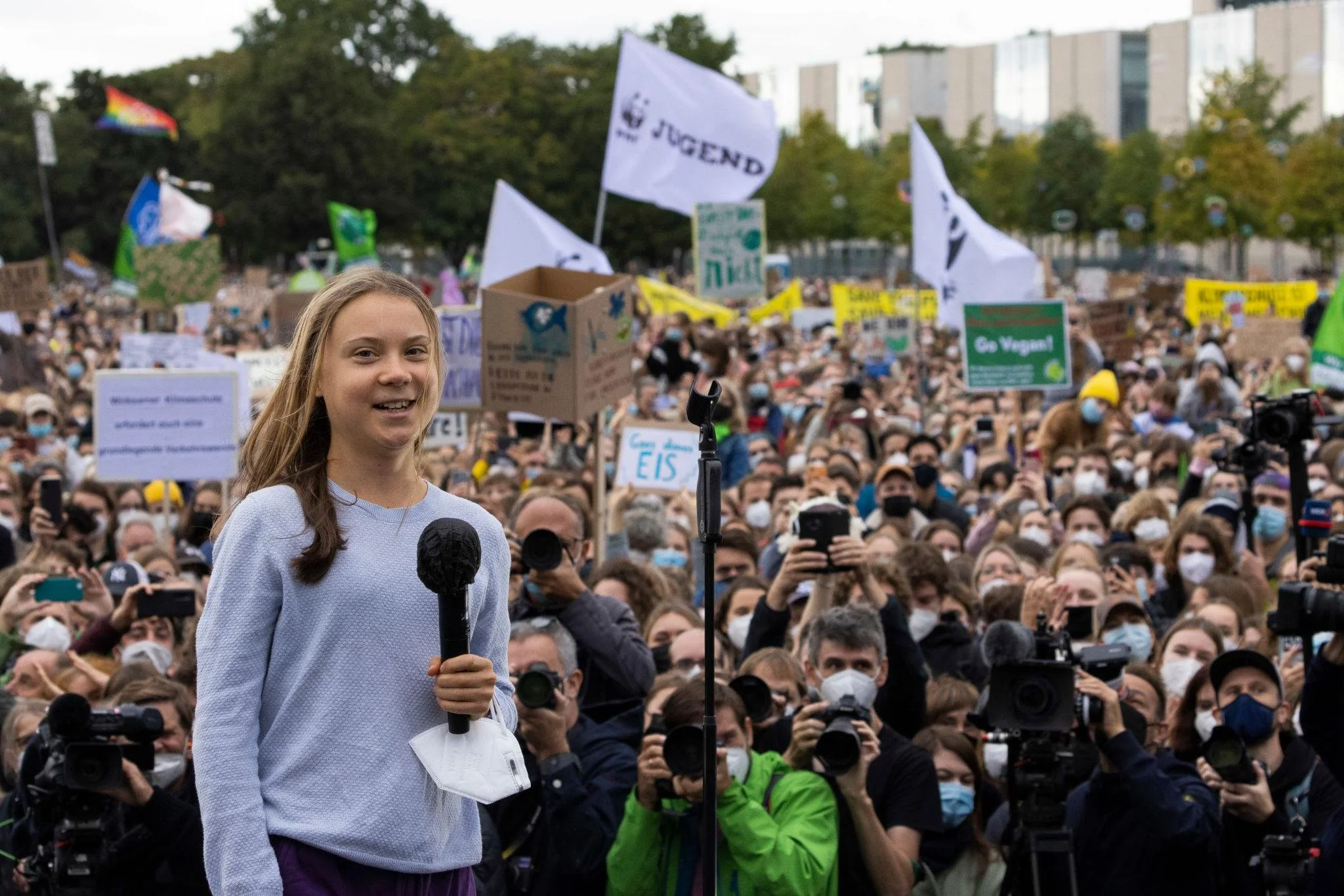
Greta Thunberg: Leadership and Community Impact
Greta Thunberg has emerged as one of the most influential environmental activists of the twenty-first century. Born in Sweden in 2003, Thunberg first gained global attention in 2018 when she began protesting outside the Swedish parliament to demand stronger government actions on climate change. Her individual school strike quickly expanded into a global movement known as Fridays for Future, which encouraged students around the world to protest political inaction on climate issues. Through speeches, demonstrations, and social media advocacy, Thunberg has become a prominent figure in global environmental activism. Her leadership exists within several interconnected communities, including youth movements, environmental organizations, and international political discussions. The influence she has developed can be better understood through leadership theories present in Craig E. Johnson and Michael Z. Hackman’s Leadership: A Communication Perspective. In particular, Thunberg’s approach aligns with transformational leadership, a theory that emphasizes inspiring followers to pursue collective change and challenge existing institutions.
Chapter 3 of Johnson and Hackman’s text explores leadership approaches such as the traits and skills perspective. These approaches suggest that leadership effectiveness is influenced by both learned abilities and personal characteristics. Greta Thunberg is influenced by both learned abilities and personal characteristics. Greta Thunberg demonstrates several key leadership skills that have contributed to her global influence. One of the most significant skills she exhibits is effective communication. Leadership scholars emphasize that communication is central to the leadership process because it allows leaders to articulate their vision and motivate others to act. Thunberg’s speeches frequently emphasize the urgency of climate change and call for immediate political action. Her address at the 2019 United Nations Climate Action Summit, in which she criticized global leaders for failing to respond to climate science, demonstrated her ability to communicate a powerful and emotionally compelling message. Another leadership skill she demonstrates is strategic thinking. Thunberg;s decision to protest every Friday created a clear and repeatable action that others could easily adopt. This strategy helped transform a single protest into an international movement. Persistence is another important skill that defines her leadership. Despite criticism from political leaders, media outlets, and climate change skeptics, Thunberg has remained committed to her activism and continues to advocate for environmental reform.
In addition to these skills, Thunberg demonstrates leadership behaviors that further illustrate her leadership style. One notable behavior is her willingness to challenge existing political and economic systems that she believes contribute to environmental harm. By publicly criticizing governments and corporations, she draws attention to the policies and practices she believes must change. Another leadership behavior is her ability to mobilize followers. Through the Fridays for Future movement, millions of students have participated in climate strikes across the world. This widespread participation demonstrates her capacity to motivate individuals to engage in collective action. Thunberg also exhibits several traits that support her leadership effectiveness. Authenticity is one of her most recognizable characteristics. She communicates directly and openly about climate change, which helps establish credibility with her supporters. Courage is another defining trait, as she frequently addresses world leaders and powerful institutions despite the scrutiny she faces. Finally, determination plays a central role in her leadership. Her consistent activism over several years demonstrates a strong commitment to her beliefs and goals.
Thunberg’s leadership style can also be understood through the concept of transformational leadership discussed in Chapter 4 of Johnson and Hackman’s text. Transformational leaders inspire followers by presenting a compelling vision for change and encouraging people to pursue goals that benefit society as a whole. Thunberg frames climate change as both a scientific and moral issue that requires immediate attention. By emphasizing the long-term consequences of environmental neglect, she encourages individuals to view climate action as a collective responsibility. Her leadership has been particularly effective among younger generations, many of whom feel that traditional political institutions have failed to adequately address environmental concerns. Through her communication and activism, Thunberg has inspired many young people to participate in political discussions and environmental advocacy.
Chapters 5 and 6 of Leadership: A Communication Perspective discuss the role of power and influence in leadership. Greta Thunberg demonstrates several forms of power described in the text. One of the most important is referent power, which arises when followers admire a leader and identify with their values. Many young activists see Thunberg as a representative of their generation and relate to her concerns about the future of the planet. This identification increases her ability to influence others. She also demonstrates elements of expert power through her reliance on scientific research and climate data. Although she is not a scientist herself, she frequently references scientific studies and encourages policymakers to follow the recommendations of climate experts. Informational influence is another tool she uses effectively. By sharing information about climate science through speeches, interviews, and online platforms, she raises awareness and encourages people to reconsider their perspectives on environmental issues.
Chapters 5 and 6 of Leadership: A Communication Perspective discuss the role of power and influence in leadership. Greta Thunberg demonstrates several forms of power described in the text. One of the most important is referent power, which arises when followers admire a leader and identify with their values. Many young activists see Thunberg as a representative of their generation and relate to her concerns about the future of the planet. This identification increases her ability to influence others. She also demonstrates elements of expert power through her reliance on scientific research and climate data. Although she is not a scientist herself, she frequently references scientific studies and encourages policymakers to follow the recommendations of climate experts. Informational influence is another tool she uses effectively. By sharing information about climate science through speeches, interviews, and online platforms, she raises awareness and encourages people to reconsider their perspectives on environmental issues.
Ethical leadership is another key topic addressed in Chapter 11 of the textbook. Ethical leadership involves considering the moral implications of leadership decisions and actions. Greta Thunberg’s activism raises several ethical considerations. On one hand, she uses her platform to advocate for environmental protection and to encourage governments to follow scientific evidence. Her message emphasizes responsibility toward future generations and the long-term health of the planet. These actions align with ethical leadership principles that prioritize the well-being of communities and society as a whole. On the other hand, her confrontational approach toward political leaders has generated debate about the role of activism in public discourse. Some critics argue that her tone can create division rather than cooperation. These differing perspectives highlight the ethical complexities leaders face when challenging powerful institutions and advocating for significant social change.
Greta Thunberg’s influence on society has been substantial, particularly among young people. The Fridays for Future movement has organized climate strikes in hundreds of cities around the world and has involved millions of participants. These demonstrations have increased public awareness of climate change and placed additional pressure on political leaders to address environmental concerns. Thunberg has also spoken at major international events such as the United Nations Climate Action Summit and the European Parliament, further amplifying her message. Her activism has contributed to a broader cultural shift in which climate change is increasingly viewed as an urgent political and social issue.
In conclusion, Greta Thunberg’s leadership illustrates how communication, persistence, and moral conviction can inspire global movements. Through her activism, she has mobilized millions of people to demand stronger environmental policies and greater accountability from political leaders. The leadership theories presented in Johnson and Hackman’s Leadership: A Communication Perspective provide useful tools for understanding how Thunberg has developed influence within the global environmental community. As Johnson and Hackman explain, leadership is “a form of human communication that influences the attitudes and behaviors of others to meet shared group goals.” Thunberg’s activism demonstrates this principle clearly, as her communication has inspired individuals around the world to take action on climate change. Her leadership highlights the power of communication to mobilize communities and address global challenges.
Work Cited Page
Johnson, Craig E., and Michael Z. Hackman. Leadership: A Communication Perspective. 7th ed., Waveland Press, 2018.
“Greta Thunberg.” Encyclopaedia Britannica, Encyclopaedia Britannica, Inc.,www.britannica.com/biography/Greta-Thunberg. Accessed 15 Mar. 2026.
Thunberg, Greta. “You’re Acting Like Spoiled, Irresponsible Children.” The Guardian, 23 Apr. 2019,www.theguardian.com/environment/2019/apr/23/greta-thunberg-full-speech-to-mps-you-did-not-act-in-time.
Carrington, Damian. “School Climate Strikes: 1.6 Million Take Part Around the World.” The Guardian, 20 Sept. 2019,www.theguardian.com/environment/2019/sep/20/global-climate-strike-school-student-protests.
“Fridays for Future.” Fridays for Future,fridaysforfuture.org. Accessed 15 Mar. 2026.
United Nations. “Greta Thunberg Address to the UN Climate Action Summit.” United Nations, 2019,www.un.org/en/climatechange/greta-thunberg-speech.

Meaning Over Noise
We’re living in a moment where anyone can create, but not everyone can connect. Content is constant, platforms are crowded, and attention is fragmented. The creators and brands that rise above the noise are the ones that understand something deeper: how to make people feel seen. That’s the space I’m learning to operate in. I’m Sam Rosen, a Social Media and Digital Strategy student and digital storyteller based in Chicago, building a career at the intersection of creativity, culture, and emotional intelligence. I’ve always been fascinated by the invisible layer behind content, the part people feel but can’t always articulate. It’s the reason one campaign lingers long after you close the app while another disappears instantly. It’s why some brands feel intimate and human, while others feel purely transactional. That difference is what first made me curious about marketing, and more specifically, storytelling as a strategic craft rather than just a creative output.
To me, storytelling is one of the most undervalued business skills of this generation. In a world saturated with content, clarity and intention have become new forms of creativity. Anyone can post, but not everyone can build meaning. That distinction shapes how I approach my work. Whether I’m developing a campaign concept, writing long form content, or analyzing a brand’s positioning, I always return to one core question: how is this making someone feel? My work lives at the intersection of strategy and sensitivity. I’m deeply analytical, but I lead with intuition. I’m drawn to frameworks such as brand ecosystems, audience psychology, and PESO models because they translate ideas into structure. At the same time, I believe strategy without emotional intelligence falls flat. Metrics can optimize performance, but emotional clarity is what makes brands feel understood. The strongest work exists where both come together.
Being part of Gen Z gives me a unique vantage point in this space because I grew up inside digital culture rather than studying it from the outside. I’ve watched trends evolve from niche communities into global conversations almost overnight. I’ve seen audiences become more self aware, more skeptical, and more emotionally literate. People don’t just consume content anymore. They interpret it. We look for alignment and question intention. I’ve experienced both sides of that dynamic. I’ve been influenced by trends, but I’ve also watched ideas ripple outward from my own circles. That dual perspective as both participant and observer has reshaped how I think about building brands today.
The creator economy rewards speed, but I’m more interested in depth. I’m curious about why some creators build lasting communities while others plateau. Why certain brands feel timeless even in fast moving industries. Why do some ideas compound rather than expire. Those questions push me to look beyond surface level performance and into the deeper mechanics of connection. Chicago has played a major role in shaping that mindset; it’s a city that values substance. There’s a grounded creativity here that feels different from more performative creative scenes. You see people building slowly and intentionally through independent brands, local creators, and community driven spaces. That environment has influenced how I think about storytelling. It’s taught me that credibility is built through consistency, not just visibility.
That perspective carries into the kind of work I’m drawn to. I gravitate toward ideas that feel layered, storytelling that holds emotional weight while remaining culturally relevant. I’m especially interested in themes like identity, nostalgia, belonging, and modern digital life. These ideas are not only aesthetically compelling but strategically powerful. They create emotional memory, and emotional memory is what builds brand equity over time. At the heart of my creative philosophy is one belief: authenticity isn’t something you stumble into but it’s something you build. It’s easy for brands to say they’re authentic but it’s much harder to operationalize authenticity across every touchpoint. In a self-aware digital landscape, audiences immediately are able to sense something feeling off. For example, a brand having a voice, dependable partnerships, and having an actual story, is why I am drawn to work that focuses on alignment. These values allow a brand's audience to gain trust with them.
As someone early in my career, I see my role as both a translator and a builder. I’m interested in translating the emotional language of digital native audiences into strategies brands can actually use. At the same time, I want to help build systems that allow brands to scale without losing identity. That balance between interpretation and construction is where I feel most energized. Creatively, I gravitate toward storytelling that feels immersive and intentional. I love blending aesthetic sensibility with narrative depth. Work that is visually compelling but intellectually grounded. Whether I’m writing, conceptualizing campaigns, or developing brand insights, I aim for ideas that feel thoughtful rather than reactive. I want work that holds up over time, not just within the algorithm.
Outside of strategy, visual storytelling has become an equally important part of how I understand the world. Photography, in particular, has shaped how I notice details and document moments that might otherwise go overlooked. It trains me to pay attention to light, mood, and atmosphere, but also to emotion. That practice has influenced how I approach branding, because at its core, strong storytelling is about perspective. Photography reminds me that meaning often lives in subtlety, and that insight carries into the way I build ideas.
What makes me distinct in this space is how I move between creativity and strategy. I don’t see them as separate disciplines. Strong creative work requires structure, and strong strategy requires emotional resonance. I’m interested in living in that overlap and understanding both the why and the how. It allows me to zoom out and see the broader ecosystem while still shaping the details that make something meaningful. I’m also deeply motivated by growth, as I see my career less as a fixed path and more as an evolving creative practice.
I’m constantly learning from campaigns, creators, cultural shifts, and even everyday digital interactions. I pay attention to what sparks conversation, what feels overproduced, and what feels honest. That ongoing observation shapes how I refine my instincts and sharpen my perspective. When I think about how I want collaborators, brands, or future employers to perceive me, a few qualities matter most. I want to be known as someone who cares deeply about their work; someone who approaches ideas with intention and curiosity; someone who notices nuance and asks better questions before jumping to conclusions. In an environment that often prioritizes speed, I want my work to signal thoughtfulness. I also want to be recognized for emotional intelligence, not just as a creative person, but as someone with awareness.
Every piece of content exists within a broader cultural and human context. Understanding that context is becoming one of the most valuable creative skills, and it’s something I actively try to cultivate in how I think and create. Collaboration is another core value for me. While the creator economy often highlights individual voices, the most meaningful work is rarely created in isolation. I believe in shared ideation, layered perspectives, and environments where creativity feels safe enough to experiment. Some of the strongest ideas emerge not from being the loudest voice in the room, but from creating space for better conversations.
Looking ahead, what matters most to me is building work that feels intentional. I’m not interested in creating for the sake of visibility or chasing relevance for its own sake. I want to build ideas that last longer than the moment they’re posted, ideas that carry emotional clarity and feel grounded in something real. Professionally, I see myself working within the digital marketing space, contributing to brands that value both cultural awareness and emotional intelligence. I’m especially drawn to roles where strategy and storytelling intersect, where I can help shape not just campaigns, but brand identity over time.
At the same time, I’m equally motivated by long term creative entrepreneurship. One of my biggest goals is to eventually own a coffee shop. Not just as a business, but as a storytelling driven space rooted in community. Coffee shops have always felt like cultural intersections to me, places where ideas form, conversations unfold, and identity takes shape. Building something like that would be an extension of the work I’m already drawn to: creating environments where people feel seen, understood, and inspired.
I’m especially energized by the evolving nature of the creator economy. Traditional career paths are shifting, and creative roles are becoming more fluid, interdisciplinary, and self-directed. That shift creates space for people who think differently; people who are comfortable moving between strategy and storytelling, structure and intuition. I’m drawn to opportunities that exist at the intersection of culture and communication. Spaces where storytelling shapes not just campaigns, but conversations. Whether through brand strategy, content ecosystems, or creator led storytelling, I want to contribute to work that feels culturally aware and emotionally grounded. The kind of work that resonates beyond the algorithm.
At the same time, I recognize that I’m still early in my journey, and I see that as a strength. Being at the beginning means I’m still absorbing, observing, and refining how I think and create. I’m learning not only from success, but from experimentation and moments that challenge my perspective. That openness is something I want to protect because it keeps the work honest.
If there’s one thing I hope people take away from my work, it’s that I care about making things that mean something; not in a loud or performative way, but in a thoughtful, human way. Work that makes someone pause, sparks recognition, and lingers just a little longer than expected. Because at its best, storytelling creates moments of connection. It reminds people that behind every piece of content is a person trying to communicate something real.
As I continue growing as both a creator and strategist, I want to be someone who builds bridges between ideas and audiences, between creativity and clarity, and between brands and the people they’re trying to reach. I want my work to reflect not just what I can make, but what I value. This is just the beginning of how I’m defining myself in this space, but I’m stepping into it with intention. I want to tell stories that resonate, build strategies that feel human, and contribute to a creative landscape that feels more thoughtful and honest. If the future of branding is built on connection, that’s the future I want to help shape.

Creating Tribes, and Building An Audience
In today’s world, ideas often spread more effectively through communities than through traditional mass marketing. People naturally trust recommendations from peers more than advertisements, making community-driven influence far more powerful. When an idea resonates emotionally or culturally, individuals are more likely to share it within their own networks, creating organic momentum. Because of this, peer-to-peer sharing feels authentic, while mass marketing can often come across as impersonal and less persuasive.
Beyond spreading ideas, communities also highlight the importance of leadership, trust, and connection, especially in creative industries. Leadership in these spaces is rooted in authenticity and emotional connection rather than simply having the biggest platform. Audiences are drawn to creators they feel aligned with and connected to. As trust grows, supporters transform from passive consumers into active advocates who willingly share, promote, and champion a creator’s work.
This concept closely relates to what Seth Godin describes as a “tribe.” A tribe is a group of people connected, connected to a leader and united by a shared idea or belief. Unlike audiences built around demographics alone, tribes are built on belonging. They thrive through interaction, shared values, and a strong sense of community identity.
As a result, ideas spread differently within a tribe than they do to a mass audience. Inside a tribe, trust and peer validation play a major role. Members reinforce and amplify ideas because they feel personally invested in them. On the other hand, mass audiences often receive ideas more passively, making them less likely to engage deeply or share them organically.
Creatives are especially well-positioned to lead tribes because their work naturally expresses identity, emotion, and culture. Artists and creators often give voice to ideas their audiences strongly relate to, which makes them powerful community builders. Their authenticity allows them to create deeper loyalty and stronger engagement than many traditional brands can achieve.
A strong modern example of this is Taylor Swift. Her fanbase operates like a digital tribe, actively engaging online by decoding clues, trending hashtags, and organizing streaming campaigns. With billions of global streams, record-breaking album sales, and sold-out stadium tours, her success demonstrates how a deeply engaged community can organically amplify a creator’s reach on a massive scale.